Outsource Digital – Part of Outsource UK Ltd. We're committed to bringing you the most interesting headlines and latest industry insight.

Showing posts with label advertising. Show all posts
Monday, November 03, 2014

The latest study from the Advertising Association has shown a 8.5% rise in advertising spend to a grand total of £4.5 billion in the three months leading to June. This is the highest spending we've seen since late 2010. It is believed a maturing attitude to digital marketing played a key role behind this growth, with Internet (17.2%), Radio (17.7%) and Display (5%) all having strong quarters.

Although the growth for the rest of this year is expected to slow to 5%, if we look to 2015 demand for Display will push Internet spending to £8.1 billion (compared to the projected £7.5 billion for 2014). Search marketing is also predicted for strong growth figures next year, growing from £3.9bn to £4.3bn between 2014 and 2015.

Tim Lefroy chief executive of the Advertising Association, says the performance of digital media so far in 2014 points to “digital and creative leadership in e-commerce”. The insight is supported by companies such as Mondelez and Diageo tightening the link between online advertisements and search marketing to move further into ecommerce, which is considered a well of untapped potential for food and drink marketers. Around 60% of UK GDP is household consumption – one of the highest – according to the Advertising Association and “e and m commerce are an increasingly large part of that picture”.

Ad spend was up across the media mix, they were all down in the first quarter of the year, but posted rises in the following quarter. The latest Bellwether report, which said over 25% of companies planned to increase the marketing spend.
Read More
Monday, September 15, 2014

Another month goes by and Facebook release another update. They take the expressions "Staying on top of your game" to another level!

"Why don't you like the adverts?"

This week Facebook announced that it will start asking users for more information after they click to hide an advert. With the new feature, users will be presented with a number of options for why they are hiding the ad, including:

  1. It’s not relevant to me
  2. I keep seeing this
  3. It’s offensive or inappropriate
  4. It’s spam
  5. Something else

The purpose is to try and improve the experience for users, and will also use the information to better target ads to other users on the site.

This may seem a little frustrating for users as its obvious that no one likes adverts! But this will be really beneficial for brands as it increases the effectiveness of targeting ads on the social platform.

Facebook; Power Editor Update

Facebook plans to roll out a number of updates to its Power Editor this month, which will make it much easier for advertisers to prepare and also preview adverts before launching them.

Facebook said the following on their planned changes; “In the past, since these ads were anchored to page posts, they were not changeable. With this change, advertisers can now create News Feed ads at scale, preview them during creation, edit them at any time, and bulk import/export them.”

Facebook is also updating its objectives, and will provide a number of new options for advertisers to choose to help Facebook optimize their ad performance.

These options include:

  1. Clicks to Website
  2. Website Conversions
  3. Page post engagement for photos
  4. Video View

These changes should simplify the process greatly for advertisers, particularly first timer users. It also makes it more accessible for people who are daunted by technology, especially when it involves parting with cash.

Facebook is Sharing King!

A new report from Fractl shows that over 8 in 10 shares on social sites are on Facebook!

Fractl analysed the one million most-shared articles from the first six months of 2014. Collectively, these articles generated more than 2.6 billion shares, and 81.9 percent of these happened on Facebook!

To put this into perspective here's the rankings of the other social sites; Twitter  (8.6 percent), Google+ (4.3 percent), Pinterest (3 percent), and LinkedIn (2.2 percent).

Social sharing has become a crucial part of online marketing and this information should be at the forefront of your mind when creating content. Every post should have a clear goal and be tailored to the social site(s) you (or your followers) plan to share this content on.
Read More
Thursday, August 28, 2014


A recent report from the CMO Council has given us an insight into marketers thoughts and plans for next year.

The most common theme; improved targeting. When asked, “What steps are you taking to maximise the impact and value of your marketing in the next 12 months?” over 60 percent said improving customer segmentation and targeting was a priority.

What else is on the horizon for marketers in 2015?

  • Localising strategies (38%)
  • Further investment in digital and online relationship building (33%)
  • Testing campaigns to validate potential impact (31%)

What does this mean for your business?

Is there anything worse than receiving a text message or email from a brand that is completely irrelevant to yourself? The opposite can be said when you receive a well thought out one, it makes you feel special. Segmentation offers you the chance to create a personalised experience for your consumers. Improved targeting can go as far as you want it to, but the more time and effort you put into it the more likely you are to improve your chances of people engaging with your brand. Demographics, geographic, buyer frequency, behavioural; these are just some of the categories by which you can segment your audience to create a relevant message.

This is really important for smaller businesses as well. With inferior marketing budgets to global brands; its important to make every penny spent as effective as possible. Local businesses normally compete on a local level which makes geographic segmentation particularly important.
Read More
Sunday, August 24, 2014

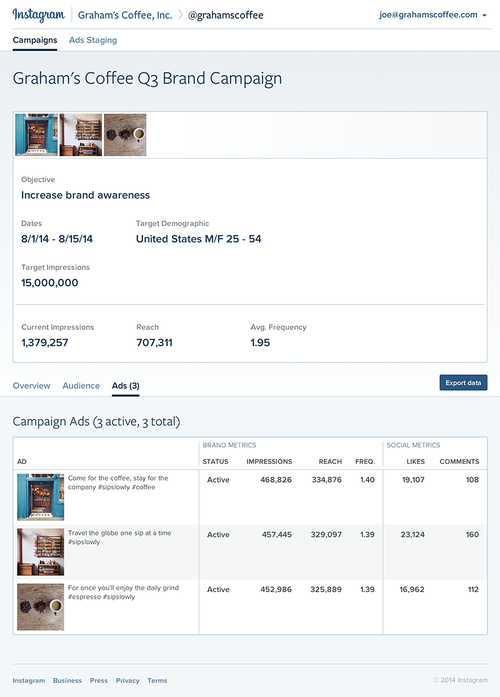
Instagram has released a new of new features that could eventually revolutionise advertising on the platform. It's been two years since Facebook splurged $1 billion buying Instagram, and its remained relatively unchanged during that period, but these recent changes definitely echo the 'Insights' pages of its parent company.

These new changes could convince many brands that Instagram is a worthy marketing platform, receiving feedback and data is essential to anything that consumes time and resources. These changes could lead Instagram's change from simple photo sharing app to powerful social network for global brands.

So what's new? 

Account insights allows brands to see how they’re increasing brand awareness on Instagram through impressions, reach, and engagement.

Ad insights shows the performance of paid campaigns with brand analytics (impressions, reach, and frequency) for each individual ad delivered to the target audience.

Ad staging allows advertisers and their creative teams to preview, save, and collaborate on ad creative for upcoming campaigns.

  
Instagram state the reasons for these developments came as a result of brands requesting more info and feedback on their posts, in particular how users engage with them. Prior to this Instagram would send data to brands manually when requested for. The above features let brands monitor the reaction to posts and campaigns, while also suggesting most effective time to post.

Before we get too excited, Instagram's plans to role out the new tools very slowly, with US advertisers receiving them first, after fine-tuning through feedback additional brands will receive them in late 2014.
Read More
Friday, August 15, 2014

Advertising through Snapchat - What you need to know!

Snapchat has been with us for over 18 months now, it's becoming hugely popular in a short space of time and takes up another precious widget space on our smartphones. We've seen that Facebook tried to buy it for $3 million and in May 2014 it was said that over 700 million pictures were being sent per day! So how can you utilise this platform to grow your brand?
  • The first thing is that is no clear way of doing it - not like other social media channels which encourage advertising on their platform and even have guides or specialised components to assist you. If you decided to advertise on snapchat, you're pretty much on your own and have to learn from success stories or trail and error.
  • This brings us on the next point, because theres no 'correct formula', its well worth checking out other examples. Big brands are really experimenting and trailing different things. A popular use of it is to give a discount code available only to snapchat users and lasting 24 hours.
  • How do you stay in someones mind when you have only 10 seconds? It's the ultimate marketing challenge. It's needs to be engaging and also unique, as well as rememberable.
  • We currently have a story telling culture in marketing, this has been evident in the rise of Storytelling roles. Snapchat is a very simplistic app with few features, but one of those is 'Story'. This allows users to create stories made up of 10 second videos that can be watched in a 24 hour period.
  • It's advert free which means you're not directly competing. Other platforms have paid advertising which can work against yourself. When you combine this with the fact that most brands aren't using it and it isn't geared towards advertising then it almost doesn't feel like you're being targeted when you get one.
  • Don't take it too seriously! Snapchat's whole concept is built on varnishing, it's never going to be your most important digital platform but its worth playing around with. It's also worth noting that there's no analytics beyond seeing the number of followers you have. Snapchat finds friends based on phone contacts, therefore for a brand it can be very hard to initially build up a following and would need another channel to push users to Snapchat.
Here's some examples to get you started:

CK One fragrance celebrated it's 20 year landmark with a huge campaign that involved a print media, snapchat and tumblr. They used snapchat to share content from the shoot and engage both ways with users.


Frozen yogurt chain 16 Handles jumped on the Snapchat train in January 2013, they asked fans to take a snapchat of themselves at one of its locations. In return, they received a snap with discount code for 16%, 50% or 100% off.


Lynx was the first brand I heard of using Snapchat. They focused of on addressing Snapchat’s reputation for ‘sexting’, as pictures could be ‘risque’, and ‘on those odd occasions where responses were close to the line, responded with an image of the new Deep Space shower gel, urging people to clean up and take a cold shower’.


Clothing retailer, Karmaloop,  has also ventured down the risqué route. They thought this was suitable to their college target audience. Everyday they sent pictures of their new clothing lines, pictures of ‘scantily clad model’s’ and exclusive discount codes. It encouraged fans to post their own videos and images.
Even though it was ‘risque’ and engaged with the ‘sexting’ associated with Snapchat, it attracted more than 2,000 Snapchat friends.

A few alternative ways to use Snapchat include; The NBA created excitement around an event by using behind the scenes clips of Kevin Durant's MVP announcement while GrubHub used Snapchat in a completely different way, they used it find and hire a summer intern.

Read More
Monday, August 04, 2014


With BMW officially signing up to be Medium's first advertiser, the blog publishing platform has been pushed back in to the public eye. But what actually is Medium and how can it benefit you?

From the co-founders of Twitter and Blogger, Medium is a platform for sharing content. We're all aware of the importance of content and Medium believe theres more to it. They are firm believers that words are the most important factor and theres much more to come in how we use them on the web.


If anyone should know about the future of the web and in particularly sharing content, these guys do! They've revolutionised the web experience on several occasions.

Why choose Medium though? They believe they have 3 factors that make it stand out compared to its competitors; 
1. It lets you focus on your words with no gratuitous sidebars, plug-ins, or widgets. While it's designed to look great on any device; it'll automatically adjust to the latest technology and even get better over time.
2. It's collaborative and you're not alone. Medium describe their community as being "part of a dynamic whole, where each part makes the others better."
3. It also helps you find your audience; "you’re publishing into a thriving, pulsing network — not a standalone web site, which you alone are responsible for keeping alive."

How does it work? 

Rather than charging on a cost per click (CPC) or cost per mille (CPM) level, BMW is being guaranteed on the total amount of minutes spent reading stories on Reform over the six-month period.

Even Hansen, Medium's senior editor, says: “We think time spent reading is a very promising new metric for valuing content online. We’ve developed some sophisticated tools for tracking active reading, which we call total time reading or TTR.

“We’ve learnt very quickly that rewarding TTR over clicks or unique visits changes the kind of content that gets made and shared – not just longer posts, thought there is that, but engaging and engrossing posts that are widely distributed and deeply read.”

Hansen adds, “We allow brands to build their own organic followers on site, so they don’t have to rely on renting an audience from publishers. And we provide an important context shift: by mixing all of the content on the site and allowing every post to compete on its own merits, brands can reach their audience more effectively than they would in a corporate blog silo or a branded microsite.”

Check out one of BMW's first sponsored posts and let us know your thoughts.
Read More
Thursday, July 24, 2014

Best of the Bad Booze!
The ASA has decided to ban Captain Morgan's recent Facebook advert, as it implied that drinking rum cures boredom. Although some of you may agree with that statement, the Youth Alcohol Advertising council took particular offence to it. 

Captain Morgan's recent Facebook advert that was banned by the ASA.
This isn't the first time Diageo has been in trouble and the alcohol industry in general has seen many banned adverts due to the sensitive nature of the product. We decided to round up some of the 'best' banned alcohol adverts and see how they compared to Diageo's latest indiscretion. 

Earlier this year WKD also had a Facebook campaign removed after a complaint from the YAAC.  It featured an image of WKD with the caption "WKD 8 BALL - Weekend Prediction - YOU WILL REFUSE TO DO KARAOKE. AT FIRST." This was said to imply alcohol could enhance confidence and was integral to the success of a social event. A harsh penalty as some would argue that you do in fact need a 'Dutch Courage' to participate in Karaoke!

Cell Drink produced a YouTube campaign which seemed more like a 'How Not To Guide' of marketing alcohol. Firstly they used Tim Sheiff a 23 year old free runner, however Advertising code states that under 25s should not be associated with drinking. The theme of the video associated dangerous stunts and physical activities with drinking alcohol, probably not the best link to use! While it was also argued the campaign appealed to under 18s. Check out the video below:


Possibly the most popular on the list. The Super Bowl has a history of debuting some of the biggest adverts in history and also a long list of since banned adverts, one of these being BudLights 2007 commercial. This advert now has just short of 20 million views online, not bad at all! This one actually doesn't relate to irresponsible drinking, rather it's just too perverted. Check it out below:


Kronenbourg, part of the Heineken family, used French legend Eric Cantona to promote the "Gallic superiority" of Kronenbourg 1664. Athough a brilliant advert, it focused heavily on the French hops used and how it was produced in the small french town of Alsace, when in reality it was brewed in Manchester and the Steisselspalts hops made up a very small proportion of the four types that were used. This led to the ASA banning the advert for misleading about the true origins of Kronenbourg.


It's not just advertising beer that can land you in trouble, anti-drinking adverts can be just as offensive. I think we all remember the shock tactics used by the government and NHS with their Know Your Limits campaign. The below image was from 2006, research has shown that children between the ages of 11 - 16 were upset by these kind of adverts.
 
Shock tactics used by the Government for their Know Your Limits campaign 2006.
Although there are many examples here of pushing the boundaries, you only have to look at brands such as Guiness and Absolut, who are masters of marketing tricky products!


Read More
Tuesday, May 20, 2014

Why Twitch could be Google's best buy
...since Youtube, anyway. Twitch is a massively popular platform for watching live-stream of video games in e-sports tournaments, with some game-playing content creators even making their entire living from ad-generated revenue on their videos. Assuming the WSJ, The Verge and Variety are all on to something Google could be about to make a very important acquisition, for $1 billion (£594 million).

As soon as “video games” were mentioned a large chunk of the mainstream media let out an audible sigh and devoted column inches to the question of – “but why would you want to watch someone else play games?!”. In the same way that Match of the Day starts each week with Gary Lineker asking,  – “So Alan, why do people want to watch other people play football?”

Twitch's not unimpressive statistics, taken from their brilliantly informative 2013 report.


As it happens people are watching other people play games – more people are watching Twitch than MTV, ESPN and Breaking Bad.

With 45,000,000 monthly users Twitch is the fourth biggest source of web traffic on the net at peak times in the US, behind only Google, Netflix and Apple. In the process beating Facebook, Valve, Amazon and Hulu. All of these statistics add up to make Twitch a massive character in the theatre of the internet and while it may belong to an audience that's largely misunderstood, it’s by no means small audience.

What’s more they’re highly engaged - the average users watches 106 minutes of video a day, compared to YouTube’s 15 minutes – and they’re obsessive about forming communities and innovating with the whole structure of live-streaming. Beyond that, perhaps most importantly of all, they’re young, with the average age user only at 21 Twitch could feasibly take many of its devotees with it for years to come. Twitch is also breaking out of its box and into increasingly less-niche territory, its native integration with both Xbox One and Playstation 4 means that it will end up in the living rooms of possibly hundreds of millions of people. More homes in the US own games consoles than don’t.

Twitch's audience of high-spending 18-34 year old men (although 1 in 3 users is female) is actually one of the hardest for advertisers to reach  as these people are abandoning TV and other platforms where they'd be ripe for traditional advertising.

Twitch is, in short, on a massive roll. It’s the YouTube of live-streaming, a leader in a game of one player, it’s increased exponentially in scale without losing engagement amongst its users. With a healthy degree of cynicism you could argue Google is buying the only even slightly viable competitor to YouTube’s market share. But its scale sees it creak from time to time, its service isn’t necessarily running at optimum and now Google with their blank cheques and fearless innovation can buy, develop and design Twitch’s way to untouchable, monolithic stability.


Read More
Thursday, May 15, 2014

Space: The final frontier for advertising.

Can on the moon.
(credit: the verge)


Japanese company Otsuka is sending a drink called ‘sweat’ (Pocari Sweat in full) to the ‘Lake of Death’ on the moon for the value of the public and media attention it will bring.

The plan is to send a payload over 236,000 miles to put a can of powdered sports drink to the moon. There’s an added bonus for the makers of the lander, Astrobiotic Technologies, in the shape of  Google’s Lunar X price for successful moon exploration.

In part it’s the scale, expense and popular opposition to the commercialisation of space that’s meant that there hasn’t been much advertising in space prior to this.

The Russian space programme was less perturbed by the idea though, blowing up an inflatable Pepsi can on Mir in 1996, before Israeli milk company Tnuva filmed a whole ad there in 1997. 

Russian astronauts inflate their space Pepsi
(credit: capcomespace)


The first ad ever filmed in space. Milk doesn't look too appetising in zero gravity, I'm afraid.

By 2001 the Russians were back at it but with the global stage of the International Space Station; accepting deliveries from Pizza Hut, shortly after slapping their logo on rockets.


Amazingly before all this in 1993 a proposal was made for a 1km squared billboard, on a low orbit above the Earth, that’d be about the same size and visibility as the moon. It was promptly abandoned when it was realised everyone was more than happy with having one actual moon, the fact that night should essentially be dark and that space is pretty packed with things that’d smash into a billboard of that size. Faced with a such a spectacularly bad idea the US government banned space advertising later that year but that was scaled back in 2005 to exclude advertising that wasn’t “obtrusive” such as on the astronaut’s suit. Right now the US is the only country that officially prohibits space advertising.

It may seem a bit of an unnecessary leap for advertising to thrust itself into space, but it might be more likely than it seems at first glance. The modern consumers' life (and let’s be realistic, we’re a long way from stopping consuming) is dominated by marketing, branding and advertising.  Even the wonderful, open and seemingly limitless web you’re reading this on is largely supported by ad revenue. If a company stands to represent the experience of the web it could easily be Google, a company that generates more than 90% of its revenue from advertising.

There comes a time when we compromise and innovate, we push messaging into places it hasn’t been before, like the first time a sponsorappeared on a football kit or an ad came through on the radio. Ads are going up into space, bit by bit and in greater numbers – whether it’s a positive democratisation of space technology, or a negative commercialisation of a wondrous frontier we're yet to even graze is a question for the same audience as always, the viewers back on the ground.

For now it’s one not so small step for a drinks can, but one giant leap (good or bad) for advertising.
Read More
Wednesday, May 14, 2014

Ridiculous Samsung ad sees mobile-augmented footballers save Earth.
#Galaxy11. Yeah, we know, there's 13, but when Landon Donovan arrives who could turn him away?


Korean electronics giant Samsung has gone way beyond the ordinary with its ludicrously scaled battle to save the planet to promote its newest smartphone the Galaxy S5 - racking up half a million views in only a day. There’s a certain charm to the premise, plus its amazingly tenuous attempts to show the S5's key features and the 4 minute spot, ‘The Training’, certainly isn’t short on entertainment value. Also  it marks possibly the only time we’ll see Messi and Ronaldo working together, despite a relatively contemptuous glance afterwards.


Under its sci-fi skin it offers some not unlikely world cup scenarios – an English player (Rooney) fails to score a penalty, Casillas gets to play a cup game and Victor Moses appears, inexplicably, but with little impact- in fact the ball actively gets up and walks away from him. More unlikely though is the six armed robot goalkeeper and hopefully the prospect of alien invasion.


If you’re going for the full experience check out to the precursor trailer, setting the scene for ‘The Training’ – aptly named ‘The Beginning’, or even the comprehensive microsite. Personally, despite not having waited all my life for a weird cocktail of Tron, District 9, Portal and football, I’m interested to see where Samsung takes the campaign next. The blockbuster approach from agency, RGA, means it certainly won’t be lost amongst shallow, unadventurous World Cup cash-in ads.
Read More
Tuesday, April 29, 2014

Winner Stays On - A complete history of Nike's World Cup ads.
Nike recently released their latest ad (perhaps even their best) and in ‘Winner Stays’ Nike have yet another top-quality pre-World Cup ad in their catalogue. As many of us look ahead to Brazil we can trust the American giant to mark out the first staging post, as ever delivered by their agency of the last 30 years, Wieden + Kennedy.

Nike's World Cup ads have gone from being standard campaigns, to a cultural phenomenon in under two decades.


‘Winner Stays’ is the ultimate spin on the Sunday kickaround, as kids transform into their heroes, a comic book character and even a postman. Unbelievable skills are on display and David Luiz continues his metamorphosis from unpredictable centre back to comedy posterboy (that’s still very good at football), while Cristiano Ronaldo and Neymar take centre stage. The brand mastery continues, neatly sidestepping Adidas by including players such as Pique and Iniesta in their Nike-made club kits rather than their country’s Adidas kits.


Back to the start though… In 1994 Nike suddenly found itself vaguely interested in football, thanks to the US hosting the world cup. Lacking the drama and grandeur of campaigns to come, ’94 settled for a simple but effective gimmick of footballers on billboards kicking it to one another across the continents.


With the detour of a surreal good vs evil match in a 1996 ad, by World Cup ’98 in France Nike was backing the winners of the previous tournament, Brazil, to the hilt. Where it not for a horrendously lethargic final performance and the magic of Zinedine Zidane, they might have been on to something too. As it was they had an airport football run-around loosely pitting the Brazilian stars against security guards in this classic ad. Bonus points for picking out the most expensive player ever, at the time, Denilson (remember him?).


For 2002, Nike was in full on classic-mode, delivering a high intensity cage match, in a underground-style football tournament. It even has Elvis as the sound track. The 4 minute spot featured almost every major footballer of the day and tournament winner Thierry Henry show-cased his cunning way before he’d ever taken a free kick when no-one was ready.


With battle-lines clearly drawn with Adidas, World Cup ’06 was in that brand’s host country. Nike went all guns blazing with a whole Joga Bonito campaign, making use of some of the first mainstream viral video tactics and pinning itself on its latest Brazilian star, Ronaldinho.


For 2010, the World Cup was back on neutral ground and Nike returned with an extended ad under the theme ‘Write Your Future’. For once Cantona didn’t get the acting gig, and a three-pronged attack of Wayne Rooney, Cristiano Ronaldo and Ronaldinho took centre stage. Along with Homer Simpson. The video was a massive hit, but the same can't be said for its stars, who all left the world cup earlier than expected, apart from Ronaldinho who didn't make it there at all. What's worse was that Adidas-wearing Spain made it 2 trophies in a row.


All of this without ever once being an official sponsor for the world cup and without Lionel Messi, (jewel in the Adidas crown) in sight. Proving that if you can make an unofficial ad and still steal all the attention while adding to the vault of great ads out there; Just do it.
Read More
Tuesday, February 18, 2014


There's been much debate as to what Apple plans to do with social media analytics firm Topsy, but it's clear that having spent $200 million recently acquiring it, that it will play an important role in future developments. Companies such as Topsy, and a number of other start ups that are growing at a rapid rate, are trying to make sense of the everyday interactions that take place across a number of social platforms. This information allows brands to monitor campaigns, to see what is working and what isn't. Social data is taking consumer profiling to the next level; seeing what users pin, like, retweet, their interactions and feedback.


Read More
Wednesday, February 12, 2014

As we entered 2014 many people have predicted real time marketing to play a big role this year. Already we've seen a number of high profile events that have resulted in a number of examples of real time marketing. This highlights what an important component RT marketing has become to top brands, as clearly they look incorporate it into their marketing strategies.

Bruce Daisley, Managing Director at Twitter, recently came out and declared that, the now infamous, Oreo 'Dunk in the Dark' tweet was 'a red herring' and something of a 'set back'. 
Read More
Wednesday, February 05, 2014

Carat wins Ad Age's 2014 Media Agency of the Year!
There was no slowing Carat down last year, they followed up a very successful year with a huge 2013. Ad Age chose Carat as the Media Agency of the Year because of their ability to kick on, they increased revenue by 20% and recruited top talent 2013, while still securing new accounts and managing their huge General Motors account.

Carat Global President Doug Ray said: "After winning so much business last year we could have gotten distracted by trying to absorb the business and being too internally focused, the goal was to avoid distraction by hiring and "scaling operations."


Read More
Tuesday, January 28, 2014

Nielsen's Adview Pulse report released it's latest findings yesterday on the state advertising in 2013. Internet was the big winner with a 32% rise in spending in the first three quarters of the year compared to 2012. 

Read More
Tuesday, July 09, 2013

Mobile dominating search and ad spend, say GroupM
Media investment giant GroupM has predicted that UK mobile advertising expenditure is set to rocket in 2014, encompassing one quarter of total ad-spend and one fifth of paid search.
Read More
Monday, June 25, 2012


After a successful debut in the U.S market, internet giant Google, in partnership with Sony, will launch their new television product in Britain towards the end of July.

Read More