Outsource Digital – Part of Outsource UK Ltd. We're committed to bringing you the most interesting headlines and latest industry insight.

Showing posts with label branding. Show all posts
Sunday, August 24, 2014

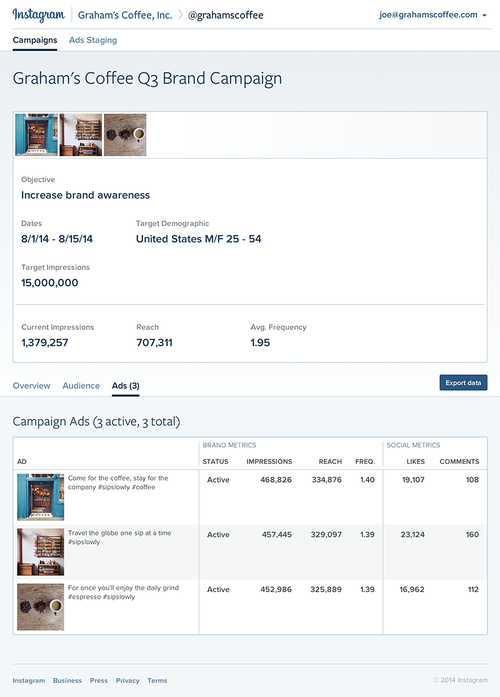
Instagram has released a new of new features that could eventually revolutionise advertising on the platform. It's been two years since Facebook splurged $1 billion buying Instagram, and its remained relatively unchanged during that period, but these recent changes definitely echo the 'Insights' pages of its parent company.

These new changes could convince many brands that Instagram is a worthy marketing platform, receiving feedback and data is essential to anything that consumes time and resources. These changes could lead Instagram's change from simple photo sharing app to powerful social network for global brands.

So what's new? 

Account insights allows brands to see how they’re increasing brand awareness on Instagram through impressions, reach, and engagement.

Ad insights shows the performance of paid campaigns with brand analytics (impressions, reach, and frequency) for each individual ad delivered to the target audience.

Ad staging allows advertisers and their creative teams to preview, save, and collaborate on ad creative for upcoming campaigns.

  
Instagram state the reasons for these developments came as a result of brands requesting more info and feedback on their posts, in particular how users engage with them. Prior to this Instagram would send data to brands manually when requested for. The above features let brands monitor the reaction to posts and campaigns, while also suggesting most effective time to post.

Before we get too excited, Instagram's plans to role out the new tools very slowly, with US advertisers receiving them first, after fine-tuning through feedback additional brands will receive them in late 2014.
Read More
Tuesday, May 27, 2014

How UKIP won the social election.
In the recent European parliament election UKIP took the most seats of any party, 24, even managing to take a seat in every constituency across the country.

UKIP are now the second most followed political party on Facebook. In taking that spot, behind The Conservatives, UKIP overtook Labour, who’ve had a combined 40 years as the ruling party in Britain.

Beyond that UKIP are dwarfing the engagement rates of the other parties, scoring a huge 87% engagement. Their growth is astronomical, increasing followers by 85% between the 29th of April and 26th of May alone, compared to the Conservatives’ 7.82% and Labour’s 3.95%.

UKIP's Facebook page buzzed with positive support, one commenter saying - "I don't recall any other political party making its voters feel a connection to each other in such a positive way".


Simply: UKIP gained fans and engaged the ones it already had at a completely unmatched rate.

While the content of UKIP’s messages was heavily criticised, it was able to build widespread furore and attention into momentum with which to push the campaign beyond the apathy surrounding the three major parties (although I think that should be ‘two’ now). UKIP’s passage on social media was not a smooth one, as seen by the hijacking of ill-advised hashtag #whyimvotingUkip but repeatedly the party was able to use opposition to project itself as a viable challenger brand.

It continued its brand-like tactics by using targeted calls to action socially, unlike the other parties, and using bold, largely unsupported statements, in a way traditional political promotion would shy away from.

Way To Blue’s data from 16th to 22nd of May shows how UKIP managed to gain 198,000 mentions socially. I think we can assume many of them were negative, but over 2,000 professed an intention to vote for the party. Meanwhile Labour, who were unlikely to have fielded as many accusations of racism or sexism, managed only 70,000 mentions with only 945 of those suggesting that’s how the user would be voting at the polling box.  By this point the Lib Dems had fallen off the map altogether, behind The Green party.


Perhaps most shockingly, as someone who’s seen a not-exactly-warm reaction to UKIP, they weren’t the party to the garner the most negative sentiment, or the least positive sentiment; those dubious honours fell to Labour (47% negative) and the Conservatives (8% positive). The filter bubble effect of social media with regards to Ukip is discussed brilliantly in this article.

It was a bumpy road for UKIP on Twitter, losing the odd MEP to controversial tweets, but the data shows the fervour created managed to balance engaged support against some pretty stinging opposition. Beyond that UKIP were able to be much more brand-led in having a figurehead of Nigel Farage that consistently grabbed headlines in a way the other parties and their leaders failed to. The result mirrored a Europe-wide swing to the anti-EU far-right (and sometimes far-left) that could have implications way beyond any level of electioneering.

Putting aside the content, UKIP’s execution and delivery outshone the other parties, creating compelling content for its audience and projecting a resolute brand. Farage’s promise of a “political earthquake” was delivered wholly on social media and that phrase alone reflects the whole campaign – not particularly reasoned or nuanced, but impactful and attention-grabbing.

Realistically if you can make half an audience love you and half audience hate you you’ll likely end up better off in a popularity contest than the options that no-one particularly feels much towards either way. Or to borrow Dan Wieden's famous phrase - "Move me dude!".

Advertising legend Dan Wieden (of Wieden + Kennedy) discussing his principles of brand communication.


Beyond this one event though the question must now be asked – could social media bring about the end of politics forever seeking the most attractive middle ground instead relying on heavily engaged niche audiences instead? With a hundred years of two-party politics it seems almost unprecedented – but that’s exactly what social brands do.
Read More
Friday, May 09, 2014

Apple + Beats: Buying headphones or buying 'cool'?
(credit: idownload)


The world’s most valuable technology company is apparently set to finally spend some of its not inconsiderable war-chest on making a major acquisition – the sort of thing that Facebook and Google do every other week. In its sights is headphone super-brand Beats, for a cool $3.2 billion (£1.9 billion).
Created by Jimmy Iovine and Dr Dre, who is doing his best to make sure no-one has ‘forgot about Dre’, the headphone brand has gone from strength to strength.

The proposed buy has been met with some fervent support and some stiff opposition, so here’s a brief rundown of what Apple stands to gain or lose:

Apple’s buying ‘cool’ – While there’s no doubt Apple’s star still shines brightly, it’s definitely lost a bit of its glow to the younger generation. This is partly down to a perceived lack-of-innovation and partly down to the fact an emotive challenger brand has become a stable, dominant industry leader.

Many have claimed Apple buying Beats equates to Apple to buying some ‘cool’ back. That sounds a bit desperate for an incomparably large tech-giant and it’s hard to know exactly how Apple would cash in on that ‘cool’. That’s ignoring it’s pretty uncool in itself to need to buy cool. Even so if Apple can come out of that relatively unscathed they’ll own one of the world’s most prominent audio brands at the moment, with the opportunity to incorporate the attractiveness of Beats into Apple’s own offering wherever they like. Free Beats headphones with iPhones for example could become something that Samsung and HTC find impossible to match.

Beats is one of the most celebrity led brands on the planet. Here's Lil Wayne. 
(credit: hiphopwired)


Apple’s buying audio credibility (if not quality) – Beats certainly come with credibility, I’m sure it wouldn’t be too hard to argue Dr Dre knows a bit more about music than Tim Cook. But the critics aren’t actually all that fond of Beats either, with them being regarded as heavily over-priced for how good they really sound. Not to mention accusation on it being reliant on style over substance. Some commentators are claiming with Apple’s past reputation for striving for the best of everything in hardware that buying Beats doesn’t represent a quality-led acquisition. Nevertheless they’re much better than Apple’s current headphones which represent one of Apple’s most common sticking points in the consumer markets – but it’s a $3bn spend on a technology Apple already fundamentally has.

Dr Dre's tagline for the Beats campaign


Apple’s getting a leading streaming service – Beats has a streaming service, Beats Music, it’s not the best or the biggest, but its successful and unlike many others it’s paid subscription only and so far people have been willing to pay $10 a month for the service. Apple on the other hand has seen its iTunes market greatly eroded by streaming services, something iTunes Radio (their one year old streaming offering) has been unable to compete with. Realistically though, if Apple were desperately after a streaming service then Spotify, Rdio or Pandora would be much better buys, so that suggests the Cupertino company are at least partly interested in Beats hardware and brand equity.

Beats Music features personalised playlist and majors on attractive design.
(credit: engadget)


What Apple’s really getting – All of those things, but not without drawbacks.
All in all despite it being Apple and Beats, two brands known for their showstopping drama, it’s a bit of a safe buy. Just how wrong can it go? It’s a solid brand with a solid product with a bonus streaming service. There’s nothing there Apple doesn’t want, but nothing that’s going to fundamentally change the landscape of consumer tech. It's neither marketing victory, nor marketing disaster.

The can of worms that’s potentially being opened though is – are Beats headphones without an Apple logo cooler than those with an apple logo? Does it matter if they are.

With all the money in the world Apple is going out and buying something it largely has, with a not outstanding reputation of quality or innovation. From my perspective this acquisition is all very ‘new’ Apple, not ‘old’ Apple – safe, rational and loosely uninspiring – but with the potential to masquerade as the opposite. The fact that we're talking about Apple buying someone who just makes headphones, rather than Apple's latest jaw-dropping innovation says more than almost any acquisition could.

Read More
Thursday, May 01, 2014

Oslo's Winter Olympics 2022 bid leads with beautiful design.
With bidding for the 2022 Winter Olympics hotting up Oslo has offered a very attractive visual identity for the event. 


Delivered by agency, Snohetta, they described their mission:

The world’s largest event for winter sports meets Nordic Simplicity.
In 2014, Snøhetta was commissioned to design the visual identity and feasibility study for Oslo 2022’s Applicant City bid. The identity of Oslo 2022’s visual language honors the inherent simplicity and openness in Nordic culture. By balancing playful graphics and strict geometry, the identity represents both the celebration of the Games and the solid planning of the Norwegian bid. The ambition for Oslo’s 2022 Winter Olympics bid is to share the genuine passion for winter sports, and invite the world to an open, friendly and sustainable celebration of sports.

We love the mix of rigid geometry, stark photography and playfully inviting type, while such a versatile identity is sure to lend itself well to digital and animated applications.
The only question mark is against the pictograms which might leave the odd, rushed, visitor scratching their head, muttering "are we absolutely sure that's a bobsleigh?!"


Certainly Oslo is winning what's turning out to be mostly disappointingly battle of the logos between the bidding nations.


With the sensory overload of Sochi and the samba feel of Brazil's World Cup and Olympics bids, it's good to see a bit of Scandinavian design flair back on the radar and Oslo 2022 gets our vote.
Read More
Tuesday, July 17, 2012

Ahead of the release of the much-anticipated film franchise "The Hobbit", Air New Zealand has been announced as an official partner of the two-film series The Hobbit: An Unexpected Journey and The Hobbit: There and Back Again.


Read More