Outsource Digital – Part of Outsource UK Ltd. We're committed to bringing you the most interesting headlines and latest industry insight.

Friday, May 09, 2014

Apple + Beats: Buying headphones or buying 'cool'?
(credit: idownload)


The world’s most valuable technology company is apparently set to finally spend some of its not inconsiderable war-chest on making a major acquisition – the sort of thing that Facebook and Google do every other week. In its sights is headphone super-brand Beats, for a cool $3.2 billion (£1.9 billion).
Created by Jimmy Iovine and Dr Dre, who is doing his best to make sure no-one has ‘forgot about Dre’, the headphone brand has gone from strength to strength.

The proposed buy has been met with some fervent support and some stiff opposition, so here’s a brief rundown of what Apple stands to gain or lose:

Apple’s buying ‘cool’ – While there’s no doubt Apple’s star still shines brightly, it’s definitely lost a bit of its glow to the younger generation. This is partly down to a perceived lack-of-innovation and partly down to the fact an emotive challenger brand has become a stable, dominant industry leader.

Many have claimed Apple buying Beats equates to Apple to buying some ‘cool’ back. That sounds a bit desperate for an incomparably large tech-giant and it’s hard to know exactly how Apple would cash in on that ‘cool’. That’s ignoring it’s pretty uncool in itself to need to buy cool. Even so if Apple can come out of that relatively unscathed they’ll own one of the world’s most prominent audio brands at the moment, with the opportunity to incorporate the attractiveness of Beats into Apple’s own offering wherever they like. Free Beats headphones with iPhones for example could become something that Samsung and HTC find impossible to match.

Beats is one of the most celebrity led brands on the planet. Here's Lil Wayne. 
(credit: hiphopwired)


Apple’s buying audio credibility (if not quality) – Beats certainly come with credibility, I’m sure it wouldn’t be too hard to argue Dr Dre knows a bit more about music than Tim Cook. But the critics aren’t actually all that fond of Beats either, with them being regarded as heavily over-priced for how good they really sound. Not to mention accusation on it being reliant on style over substance. Some commentators are claiming with Apple’s past reputation for striving for the best of everything in hardware that buying Beats doesn’t represent a quality-led acquisition. Nevertheless they’re much better than Apple’s current headphones which represent one of Apple’s most common sticking points in the consumer markets – but it’s a $3bn spend on a technology Apple already fundamentally has.

Dr Dre's tagline for the Beats campaign


Apple’s getting a leading streaming service – Beats has a streaming service, Beats Music, it’s not the best or the biggest, but its successful and unlike many others it’s paid subscription only and so far people have been willing to pay $10 a month for the service. Apple on the other hand has seen its iTunes market greatly eroded by streaming services, something iTunes Radio (their one year old streaming offering) has been unable to compete with. Realistically though, if Apple were desperately after a streaming service then Spotify, Rdio or Pandora would be much better buys, so that suggests the Cupertino company are at least partly interested in Beats hardware and brand equity.

Beats Music features personalised playlist and majors on attractive design.
(credit: engadget)


What Apple’s really getting – All of those things, but not without drawbacks.
All in all despite it being Apple and Beats, two brands known for their showstopping drama, it’s a bit of a safe buy. Just how wrong can it go? It’s a solid brand with a solid product with a bonus streaming service. There’s nothing there Apple doesn’t want, but nothing that’s going to fundamentally change the landscape of consumer tech. It's neither marketing victory, nor marketing disaster.

The can of worms that’s potentially being opened though is – are Beats headphones without an Apple logo cooler than those with an apple logo? Does it matter if they are.

With all the money in the world Apple is going out and buying something it largely has, with a not outstanding reputation of quality or innovation. From my perspective this acquisition is all very ‘new’ Apple, not ‘old’ Apple – safe, rational and loosely uninspiring – but with the potential to masquerade as the opposite. The fact that we're talking about Apple buying someone who just makes headphones, rather than Apple's latest jaw-dropping innovation says more than almost any acquisition could.


Read More
Wednesday, May 07, 2014

The Robots: Taking your job, taking your girlfriend.
Despite looking like a young Robocop, this guy just plays ping pong. "You have 40 seconds to serve".

It’s been revealed in a report that 1 in 3 Britons fears that a robot will be taking their job in the near future. Jobs that are dull, dangerous or dirty look set for robot overhaul, with our metallic friends more than able to pick up simple routines in defined structures. However anything more complicated than picking up one thing in one place, following one route and putting it down in another unchanging place is likely to flummox a robot. Even ironing is beyond them. 

Other headline stats - 39% of Britons fear that robots pose a definite threat to humanity, while 17% of people are willing to have sex with a robot. We hope they’re not the same, very confused, people. Another recent report suggests 702 currently human jobs are in danger of becoming robot territory.

It’s an interesting question to ponder for our specific digital sector as the work in PPC and SEO exists entirely in the digital space, which oddly means the nuances and human strategy takes it far away from something easily-automated like factory work. In terms of SEO though are we already working for an inorganic algorithm? Does programmatic buying add up to robots doing PPC?

Robots are already making a better job of saving lives (in hospitals) and taking lives (on the battlefield) so it’s not surprising to hear that they might be taking up the reins of many things in between.

If about 50 years of Hollywood hasn’t convinced you robots might not be fantastic, even Stephen Hawking is chipping in now. The true tipping point may come when it’s cheaper to build a robot than employ a person on minimum wage, as whether it’s robots or humans in charge capitalism is likely to win out.

This robot is fantastic at making Japanese pancakes.

Martin Smith, Professor of Robotics at University of Middlesex offered a calming voice though, saying “While many of us worry about the role of technology and machines in modern society, robots are increasingly being developed for important roles that will help protect and improve our lives.

"Though many fear their jobs will be taken over by machines, it is more likely that robots will be used as assistants, and the future workforce could have the benefit of avoiding hazardous and repetitive tasks rather than suffer mass redundancies.”

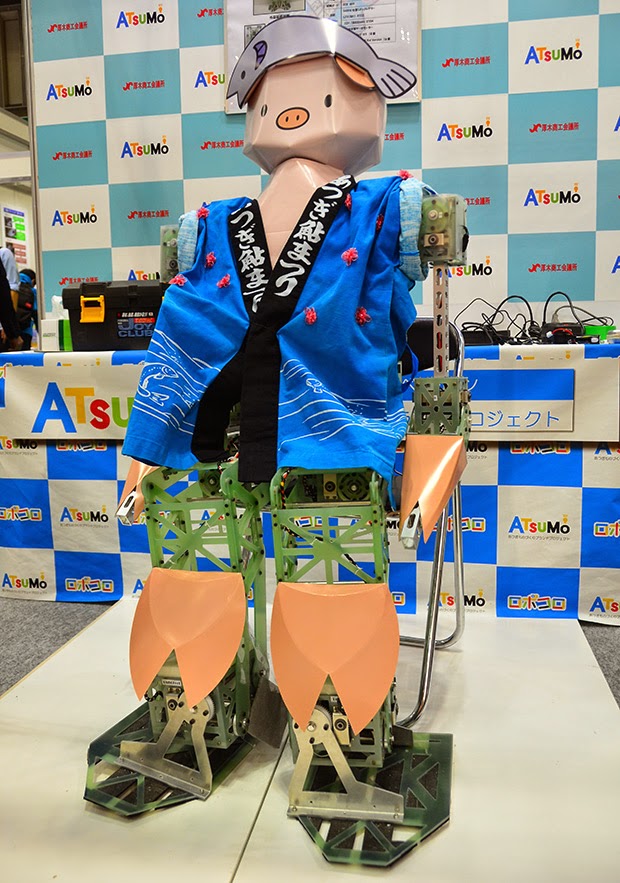
Could this robot do your job?

Read More
Tuesday, May 06, 2014

The tightening of wages – when performance matters more than ever.

Cold winds of change: CEO pay freeze in the financial district.
(credit: Royal Mint Gardens)


Salaries across major business are undergoing significant changes, as performance becomes a greater guarantee of financial reward than the job titles themselves.

In the wake of the financial crisis the worth and contribution of any individual is more under question than ever, as society finds a new, deeper distrust for established, opaque hierarchies. A movement of accountability and transparency has taken hold, set against a back drop of financial turmoil and shareholder mistrust.

In short, more than ever, everyone wants to be sure you’re not getting paid for what you’re not doing. From this though evolves an opportunity, where people who excel have the potential to greatly improve their standard earnings through bonus structures.

Within the elite FTSE companies 25% have seen their CEO’s pay frozen. More tellingly 70% of new CEO appointments are internal, and on average they’re taking in 13% less than their predecessor. As these are often the key markers in economic change it’s no surprise to see the pattern repeated in Chrysalis’ own sectors – Chris Crawford, Managing Director states:

“We’ve noticed a rise in packages that include a bonus; increasingly candidates are slightly lowering salary expectations while understanding through strong performance they can increase the financial rewards. It’s a valuable system that rewards achievement, while still providing the incentive for any employee to continue to progress.”

Handling major accounts for blue-chip clients at global agencies or client-side at noteworthy companies it’s inevitable that digital sector workers face the same enhanced emphasis on their output and are rewarded accordingly.


It leaves us here at Chrysalis with one thought – you’ve more chance to define your worth than ever.
Read More
Friday, May 02, 2014

Disney can make a speaker out of anything with 3D printing.
Disney, of cartoon mouse fame, has created a 3D printing technology with the capability of turning any object into one capable of emitting sound. While they’re not an obvious tech titan, Disney, actually has a fearlessly innovative R&D division, that’s tasked with creating their trademark magical experiences. Previously they've turned a fairly unremarkable plant into a working touch interface and even a musical instrument. 

A 3D printed speaker capable of producing sound without any magnets


As well creating audible sound, the speakers will be capable of producing ultrasound, inaubidle to humans but useful in the tracking of objects, making each individual object potentially part of a grander scheme of communicating local objects.

Ultrasonic range-finding in action, even if the mouse looks quite apprehensive about it.


What it means for consumer electronics is the potential for any object to be able to deliver audio reports, warnings or just sounds that enhance the experience. From the freezer door that can remind you to shut it to the electrode coated room of true-to-life sound, in moving beyond standard speakers, we’re prepared for a world of sound from every direction and every surface. Or more than likely a Mickey Mouse, that's more lifelike and 'magical' than ever.

For a full-on technical description, here's extremetech's explanation:
"The secret sauce in this breakthrough is Disney Research’s use of electrostatic speakers. Conventional speakers (in your headphones or subwoofer) use electromagnetism to move a magnet back and forth, hitting the air around it, creating sound waves (pressure waves) that your ears register as sounds. Electrostatic speakers on the other hand have no moving parts — there’s a thin, conductive diaphragm (nickel in this case) and an electrode plate, separated by a small amount of air. When current is applied to the electrode, electrostatic force deforms the diaphragm, causing it to vibrate and create sound waves.

In the case of Disney Research’s 3D speakers, the researchers use a 3D printer to create the object, and then spray on a nickel-based paint on the areas that should emit sound. The diaphragm is produced separately (also with a 3D printer) and sprayed with the same paint. By using multiple electrodes, it’s possible to control different regions of the 3D-printed object/speaker independently, too (so, it might emit different sounds from different regions). Depending on the shape of the active region, the sound might be directional (conical) or omnidirectional (spherical). The completed device is then assembled. In the future, when 3D printers can lay down multiple materials (including conductive materials), these manual steps could be omitted and the whole thing could be made in one shot."

Read More
Thursday, May 01, 2014

Oslo's Winter Olympics 2022 bid leads with beautiful design.
With bidding for the 2022 Winter Olympics hotting up Oslo has offered a very attractive visual identity for the event. 


Delivered by agency, Snohetta, they described their mission:

The world’s largest event for winter sports meets Nordic Simplicity.
In 2014, Snøhetta was commissioned to design the visual identity and feasibility study for Oslo 2022’s Applicant City bid. The identity of Oslo 2022’s visual language honors the inherent simplicity and openness in Nordic culture. By balancing playful graphics and strict geometry, the identity represents both the celebration of the Games and the solid planning of the Norwegian bid. The ambition for Oslo’s 2022 Winter Olympics bid is to share the genuine passion for winter sports, and invite the world to an open, friendly and sustainable celebration of sports.

We love the mix of rigid geometry, stark photography and playfully inviting type, while such a versatile identity is sure to lend itself well to digital and animated applications.
The only question mark is against the pictograms which might leave the odd, rushed, visitor scratching their head, muttering "are we absolutely sure that's a bobsleigh?!"


Certainly Oslo is winning what's turning out to be mostly disappointingly battle of the logos between the bidding nations.


With the sensory overload of Sochi and the samba feel of Brazil's World Cup and Olympics bids, it's good to see a bit of Scandinavian design flair back on the radar and Oslo 2022 gets our vote.
Read More