Outsource Digital – Part of Outsource UK Ltd. We're committed to bringing you the most interesting headlines and latest industry insight.

Showing posts with label instagram. Show all posts
Saturday, August 30, 2014

Homeaway - The online holiday rental company took the decision to appoint former Visa and Vodafone marketer Mariano Dima as chief marketing officer. A newly created role that will oversee all global marketing, corporate communications and brand initiatives. Dima's CV includes 20 years of marketing, product and business development for brands that cinlude PepsiCo, Vodafone, Levi Straus and Visa.

Regus - Eva Eisenschimmel has become the latest senior marketing executive to join Regus. She follows Rick Vlemmiks who joined as their most senior marketer last year. Eisenschimmel, who left Lloyds earlier this year after three years as group marketing director, joins in september and has been tasked with looking after the company’s global marketing efforts.

Ryanair - Ryanair has appointed John Hurley as its first chief technology officer, this move comes as Rynair attempts to forge its 'online travel revolution' that will ‘change the world of online air travel’.
Hurley will be responsibile for developing its fledgling digital and technology strategy, with the company in the process of recruiting a team of up to 200 people across marketing, content and strategy that Hurley will oversee. Hurley joins from educational publisher Houghton Mifflin Harcourt where he was vice president of software development.

Instagram - James Quarles has made the move from parent company Facebook to his new role as global head of business and brand development for Instagram.
Quarles will be responsible for the overall growth of Instagram as well as “building a broad asset of solutions for brands of all sizes on Instagram”.
The move means he will have to relocate from London to Instagram’s US headquarters and report into the company’s founder and CEO Kevin Systrom.
Instagram has been “deliberately” slowly rolling out advertising on the app since it first began trialling ads with a small group of brands in the US last November. Read more about Instagrams new features.

National Trust - Jordan replaces Clare Mullen, who left 4 weeks ago to move to India. She will take over towards the end of the year, although a date has not yet been set. Harry Heeley, previously commercial director at the Trust, is running the marketing department in the interim.
Jordan’s appointment comes as the National Trust renews its focus on digital. It will relaunch its website and mobile app at the start of next year to shift away from just providing information about its properties to offering more engaging content personalised to visitors based on where they live and their previous visits.

Buzzfeed - BuzzFeed has appointed ad sales veteran Greg Coleman as its new president with the task of ramping up its social advertising offering to brands. He joins from Criteo, where he was president. His other experience includes being a former president and chief revenue officer at Huffington Post and vice president of sales at Yahoo. Coleman replaces Jon Steinberg who left last month to join the MailOnline.
In addition to overseeing sales, creative services, marketing and products and business development, he is tasked with securing a greater share of brands’ ad budget for Buzzfeed’s social advertising offering.

Apple - Musa Tariq has been hired by Apple as they are set to increase their social media activity, something that has been discipline it has been slow to embrace. They hope that Musa, who is viewed as a pioneer in the social media world, will help push the brand on through community management and viral content.
The former Burberry social media director reunites with the fashion house’s previous chief executive Angela Ahrendts, who became senior vice president of Apple Retail in May.
Apple has very few social media accounts with the company discounting the need to engage fans constantly to buy its products until recently. Tariq is tasked with resolving the limited presence, an area chief executive Tim Cook has looked to address through a string of high-profile hires and acquisitions.
Read More
Sunday, August 24, 2014

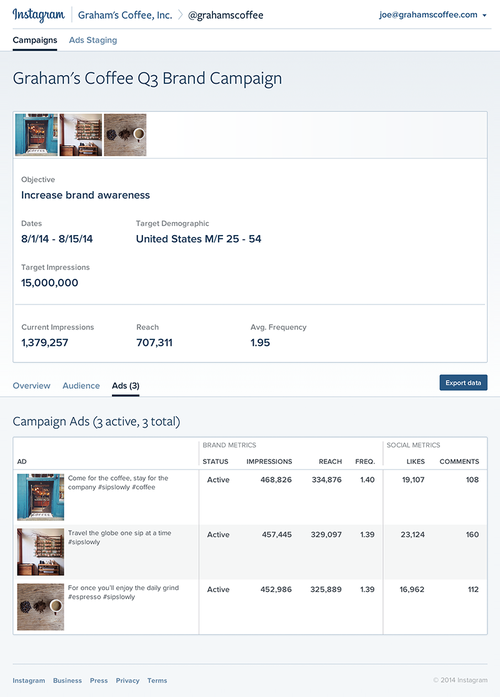
Instagram has released a new of new features that could eventually revolutionise advertising on the platform. It's been two years since Facebook splurged $1 billion buying Instagram, and its remained relatively unchanged during that period, but these recent changes definitely echo the 'Insights' pages of its parent company.

These new changes could convince many brands that Instagram is a worthy marketing platform, receiving feedback and data is essential to anything that consumes time and resources. These changes could lead Instagram's change from simple photo sharing app to powerful social network for global brands.

So what's new? 

Account insights allows brands to see how they’re increasing brand awareness on Instagram through impressions, reach, and engagement.

Ad insights shows the performance of paid campaigns with brand analytics (impressions, reach, and frequency) for each individual ad delivered to the target audience.

Ad staging allows advertisers and their creative teams to preview, save, and collaborate on ad creative for upcoming campaigns.

  
Instagram state the reasons for these developments came as a result of brands requesting more info and feedback on their posts, in particular how users engage with them. Prior to this Instagram would send data to brands manually when requested for. The above features let brands monitor the reaction to posts and campaigns, while also suggesting most effective time to post.

Before we get too excited, Instagram's plans to role out the new tools very slowly, with US advertisers receiving them first, after fine-tuning through feedback additional brands will receive them in late 2014.
Read More
Monday, June 23, 2014

The Discussion: The Rise of Anti-Social Media?

The Rise of Anti-Social Media: Are the major social networks getting less and less social? 

That's the question we asked to some top experts from digital agencies. Here's what they had to say.

Let's start with the thoughts of Dan Sodergen (@ukmarketinghelp) a Digital Marketing consultant and regular events speaker.


"Many marketing people have gotten used to an easy life. Social was about posting and now they cry “foul” because the platforms on which they post change the rules.

As for the idea that new platforms are “anti brand / anti social” this is nonsense. Such platforms protect their early adopters before they cross the chasm and change strategy. Some will do so better than others. In my mind "old boy" Twitter with well-timed advertising is the best so far for non-intrusive value add for content distribution. But ‘new’ formats like Pinterest’s new tools for businesses, Snapchat’s new events for brands, and powerhouse content centers like BuzzFeed all have or are sponsored and might be amazing.

But what is amazing is that BuzzFeed with around 3,000 articles produced 20.7 million likes, 13.7 million comments, and 47.5 million interactions in March alone. How? They gave people want they wanted which is mainly things about themselves and things that entertain them and their friends.

As someone wiser than I said many moons ago* "If you're going to crash the party, bring some champagne with you."

If brands are producing something which doesn’t get shared – they need to look themselves for interrupting people’s lives with branded cheap wine rather than the glass it comes in."


Sarah Bradley (@sarahmbradley), Head of Social, at Receptional (@receptional) and an Editor at State of Digital, takes a stand against our (admittedly provocative) title and makes a great point - if brands find it hard to reach their audience then their strategy is at fault.

"I don’t think any changes we have seen within social networks are ‘anti-social media’! The nature of social media is that it’s reactive, fluid and ever-changing. Networks are desperately trying to keep up with the way we use their networks, so changes such as the Twitter mute option and new networks like Snapchat are simply a natural progression of social networking today. A successful network provides its users with the space they need to make it their own. Take Facebook for example: launched in 2004 as a University-based network, Facebook quickly became popular with people who used university emails to create an account so Facebook expanded. Back then it was primarily text based - status updates, comments etc. Until massive picture share that started to mould the way we communicate online today so Facebook adapted again.

New ways of communicating have evolved in the past 10 years and social networks have to try and respond to, and anticipate, as many of these ‘evolutions’ as they can to remain popular; they are businesses after all.

If brands who use social networks are finding it harder to reach their audience, it’s their strategy that is at fault, not the network. Today’s consumers expect more from their brands.

Paid content will remain successful as the way it is placed before consumers is evolving too; social network paid ads are sophisticated, fun to run and cheap as chips so are still a viable option for many. However they cannot be successful without a great, adaptive strategy behind them with content that captures attention and isn’t ‘sales focussed’. The brands who do well with social media remember their customer’s interests come first and that interactions happen when they are happy or interested; sales should rise naturally as a result of customer happiness."


Sian Ediss (@fox_creative_), Head of Social, Online Ventures Group (@ov_group)  offered an amusing personal take on the sanitisation of social networks and rued the loss of Keanu Reeves memes:

"Facebook is going through a midlife crisis, what was once a fun and engaging platform is now a minefield of ‘Dos and Don’ts’.  Brands have been discouraged to ‘like-bait’ as poor Facebook is feeling played. Users have also been told by Mr FB that memes are no longer quality content, I for one, will never tire of seeing the Keanu Reeves dumbfounded face. Ever.

Quality content is what social platforms are looking for, this is important, but the freedom of social media is what makes it an exciting and creative place to hang out. With rules and regulations, muting and ‘tellings off’, I can’t help but feel a bit stifled in the "anti-​social media​"​ world of late."

Just for Sian, here's our favourite 'Conspiracy Keanu'


BadMan Media (@badmanmedia) brings an interesting arsenal of figures and proves that the shift from image to video hasn't quite taken full swing yet.

"Social media activity is an important aspect of brand marketing. Determining the impact of content, activity and time spent on the network is critical to deciding how to move forward, how to adjust and how to actively engage users.
Facebook knows that spammy content has cluttered news feeds
"Like-baiting" refers to posts that explicitly ask readers to like, comment, or share the post in order to get more distribution. According to Facebook, these types of posts are 15% less relevant than other stories with a comparable number of likes, comments, and shares.
Ideally a lot of brands now are heading over to Twitter more to engage and share content with their followers but now with the Mute button being introduced it's even harder and more important for companies to watch and take care in what content they post and share.

Anyone can say they are a social media ''expert'' but now it's becoming more of a skill and takes more than just posting a tweet or sharing a photo on Facebook
Companies have to adapt to these changes rapidly before they fall behind and become just another fish in a very, very large pond.

When Instagram revealed its 15-second video feature, it received a lot of buzz in the media. Overall, video seems to be making an impact, but photos still receive 37 interactions for every 1,000 followers, compared to 24-per-1,000 for videos. Fortune 500 companies have been slow to adopt the feature, as well, with only 74 videos shared in the past 30 days. In that same time period, the companies shared 1,792 photos. This helps support the claim that Instagram is still a photo sharing site at its core. And many people are now using Instagram to follow brands because of this.
Overall, these advertisers are watching Twitter and other social networks to see what topics are getting the most attention, and putting together short blog posts, tweets and videos that match those themes - in hopes that the online audience will become more aware of the brand and see it as relevant to their interests and needs. Then, if one topic isn't getting attention any more, the companies can drop it without much fuss, and switch gears quickly to follow the next hot discussion.

#KeepItBadman"


Rob Goodswen (@robgoodswen), Social Media Executive, Access Advertising (@accessdigital), zoned in on the shift towards paid advertisement.

"The recent push toward paid advertisement by the major players in social, particularly Facebook, has made it increasingly difficult to reach your audience organically. This is a clear power play by Mr. Zuckerberg, a man who has a world of information at his command and whether you agree or not it’s a fairly smart one. With over a billion users, Facebook is the flagship of social media. People spend inordinate amounts of their day scrolling through their feeds and for that simple reason brands will pay for their posts to be seen. If you don’t like it, switch platforms.

Content, content, content. It feels as though this is now the industry buzzword. If you have good content are you guaranteed to have it seen by anyone? NO. Why would just ‘good content’ boost your organic reach? If there was a man in charge of how many eyes see a particular post I believe that he would be inundated with that many requests for more reach that he simply wouldn’t give two shits if the content was good. He wouldn’t have time to read it. Content is key when people click the link which takes them to it. The craft of the message which intrigues people to want to read your content is the first important step.

The Twitter ‘mute’ function is an essential tool for users who don’t wish to see tweets by people that they don’t want to unfollow but don’t want to hear from any more. Sure some users might want to ‘mute’ a brand, but all that means is that the brand has failed to continue to appeal to the user. Social marketeers shouldn’t be put off by this, rather they should concentrate on producing less annoying/offensive or illegible tweets.

Is social media becoming less social? I’m not sure. What I am sure about is that increasing amounts of people are taking on social media based roles without much knowledge of the craft. We wouldn’t trust a first year graphic designer with a full re-brand project for Apple would we? If companies invested more in their social department, adopting a strong and easy to follow social media policy, social media would be a much better place. Stop getting the teaboy/girl to do your social. Idiots."

So many great points above, on a wider level I think this shift represents a change in both how we use social networks and the internet and our expectations from those things. For arguably the first time in the modern era a generation is growing that can separate itself from intrusive, unwanted advertising - which means the platforms for advertising must change their behaviour accordingly. Concerns about privacy and over-sharing have led to much more closely-knit groups sharing more personal content and the rise of ephemeral media, such as Snapchat, has offered an ingenious antidote to data that exists permanently with ever-diminishing context. 

Our relationship with social networks might have reached a point where the novelty of ease of communication, with brands, acquaintances and friends has worn off. Now people are looking to hone and improve their experience, as well as having an increased sense of their own place within relationships, their security and their vulnerability.

Thanks to all our excellent contributors. 

The Discussion is never over, look out for a new topic in the coming weeks!

What do you think - is social media turning away from its sharing values in search of cold hard cash, or just responding to user behaviour?

Get in touch @chrysalisrec and @_matthewdavies, if you'd like to add your guest opinion to the next discussion, e-mail matthew.davies@chrysalisrecruitment.com


Read More
Friday, March 14, 2014

Video ads hit Facebook, Zuckerberg calls Obama and Instagram signs its first ad deal
With a sense of inevitability Facebook has finally announced that premium video adverts are coming to the platform for a ‘select’ band of advertisers. Users will be presented with a 15 second clip, on mute, that can be scrolled past to ignore or enlarged to add sound. In a web environment that is dominated by high-intensity ads with increasingly intrusive tactics Facebook’s proposals seem relatively unobtrusive and likely won’t have you losing too much time between all the heart-wrenching viral videos and pictures of cats. Interestingly the ads will be bought and measured in the way TV ads are, rather than adopting a new basis for the platform.

Here come the videos! 
(credit: cnet)


Meanwhile Facebook head honcho Mark Zuckerburg is making phone calls to the most powerful man on the planet, American president Barack Obama. Zuckerberg argued the American government should be presenting the internet as one of its greatest assets, rather than existing as its greatest threat. As he explained “I've been so confused and frustrated by the repeated reports of the behavior of the US government. When our engineers work tirelessly to improve security, we imagine we're protecting you against criminals, not our own government. The US government should be the champion for the internet, not a threat. They need to be much more transparent about what they're doing, or otherwise people will believe the worst. I've called President Obama to express my frustration over the damage the government is creating for all of our future. Unfortunately, it seems like it will take a very long time for true full reform.”
Wrapping up the story for all things big under the Facebook banner, is that its 715 million dollar purchase, Instagram has signed its first ad deal. Starting as they mean to go on Instagram have agreed a contract with the not inconsiderable might of Omnicon. The recent $100 million deal has already attracted some positive discussion, with Forbes offering these four reasons for the ad deal being a promising one. Instagram has, perhaps wisely, chosen the Twitter route of having ad content fit in just as a regular tweet would in a stream that remains largely coherent.
All these events against the backdrop of a booming stock and a muted deviation from their “move fast and break stuff” mantra makes for blue skies over the land of Facebook. It seems as Facebook is maturing, it’s growing its advertising options sympathetically for both the users and the agencies.
Read More